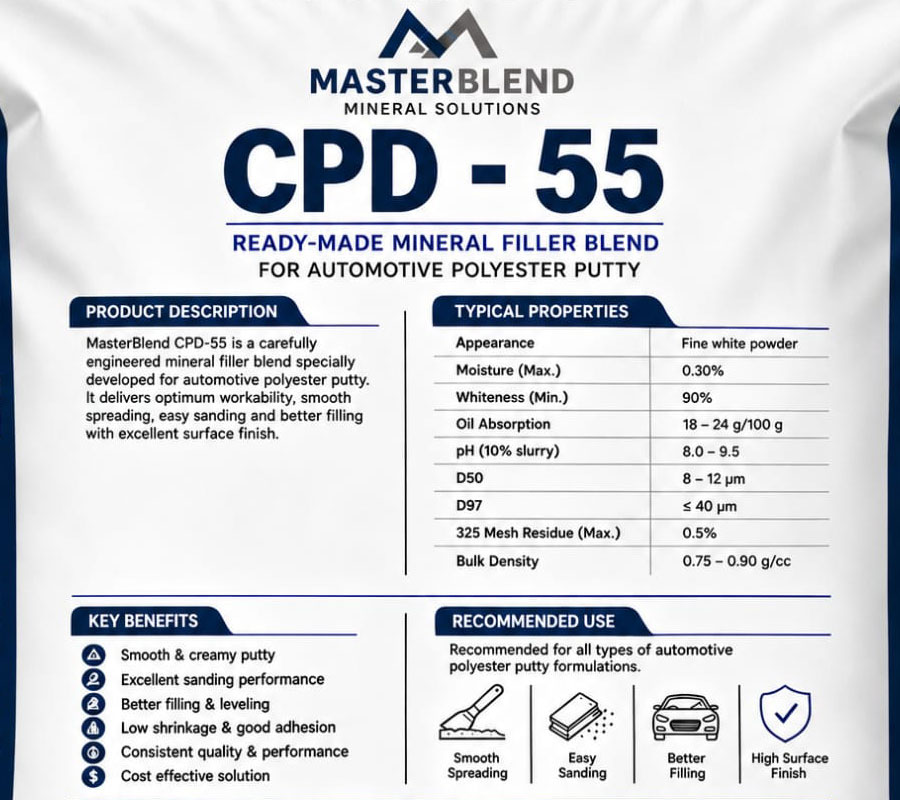
Typical Properties
Key Benefits
Good Filling & Body
» Provides mineral loading and body suitable for polyester putty formulations.
Smooth Application
» Designed to support smooth spreading and good workability during application.
Controlled Oil Absorption
» Oil absorption of approximately 22 g/100 g helps provide manageable resin demand.
Fine Surface Finish
» Low coarse residue supports a smoother finished putty surface.
Easy Sanding Potential
» The mineral blend is designed for automotive filler systems where sanding characteristics are important.
High Whiteness
» L* whiteness of approximately 96 provides a clean, light-coloured mineral base.
Consistent Mineral Blend
» Pre-blended material can reduce the need to weigh and mix several individual mineral fillers during production.
Recommended Use Level
For initial formulation trials, CPD-55 may be evaluated at approximately 40–60% of the total finished putty formulation by weight, depending on the resin system, desired viscosity, density, hardness, sanding characteristics and application properties.
A practical starting point is approximately 50–55% CPD-55, followed by laboratory adjustment according to the required performance.
The optimum loading should always be established through formulation trials with the customer's specific polyester resin and additives.
General Mixing Procedure
1. Charge the required polyester resin into the mixing vessel.
2. Add wetting/dispersing additives where required by the formulation.
3. Introduce CPD-55 gradually under continuous mixing.
4. Mix until the mineral blend is completely wetted and uniformly dispersed.
5. Adjust viscosity and application characteristics as required.
6. De-air the finished putty where suitable equipment is available.
7. Pack the base putty according to the manufacturer's normal process.
The peroxide hardener should be supplied and handled separately according to the resin/hardener supplier's recommended system.
Formulation Development
The following starting range may be considered for laboratory development:This is a development guideline rather than a finished commercial formulation. Final percentages should be optimized for the selected resin, required density, viscosity, drying/cure behaviour, adhesion and sanding performance.
Quality Control Guidelines
Finished putty manufacturers should evaluate:
» Spreading/application behaviour
» Viscosity and consistency
» Sag resistance
» Sanding performance
» Surface smoothness
» Adhesion to intended substrates
» Cure time with the selected hardener
» Pinholes and air entrapment
» Shrinkage after curing
» Storage stability
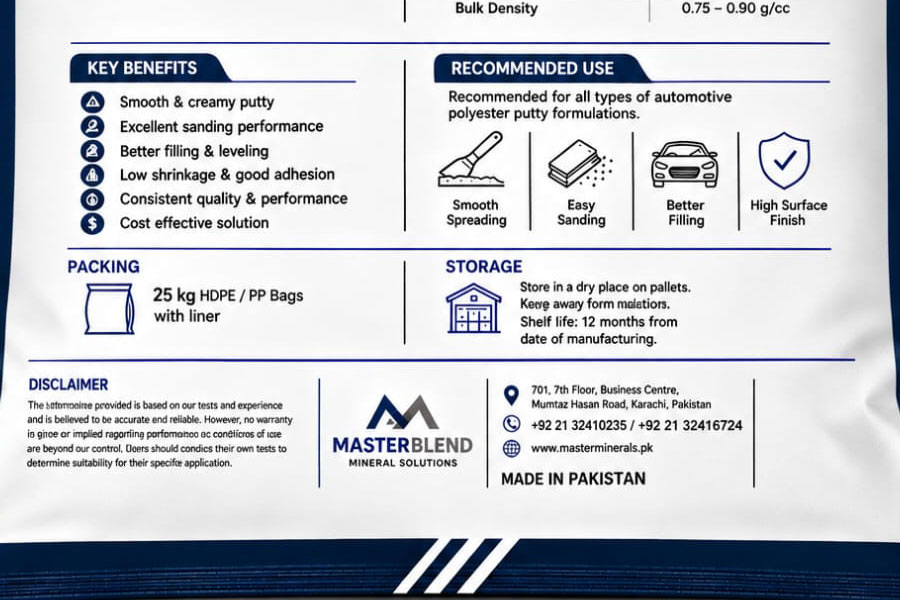
Packaging
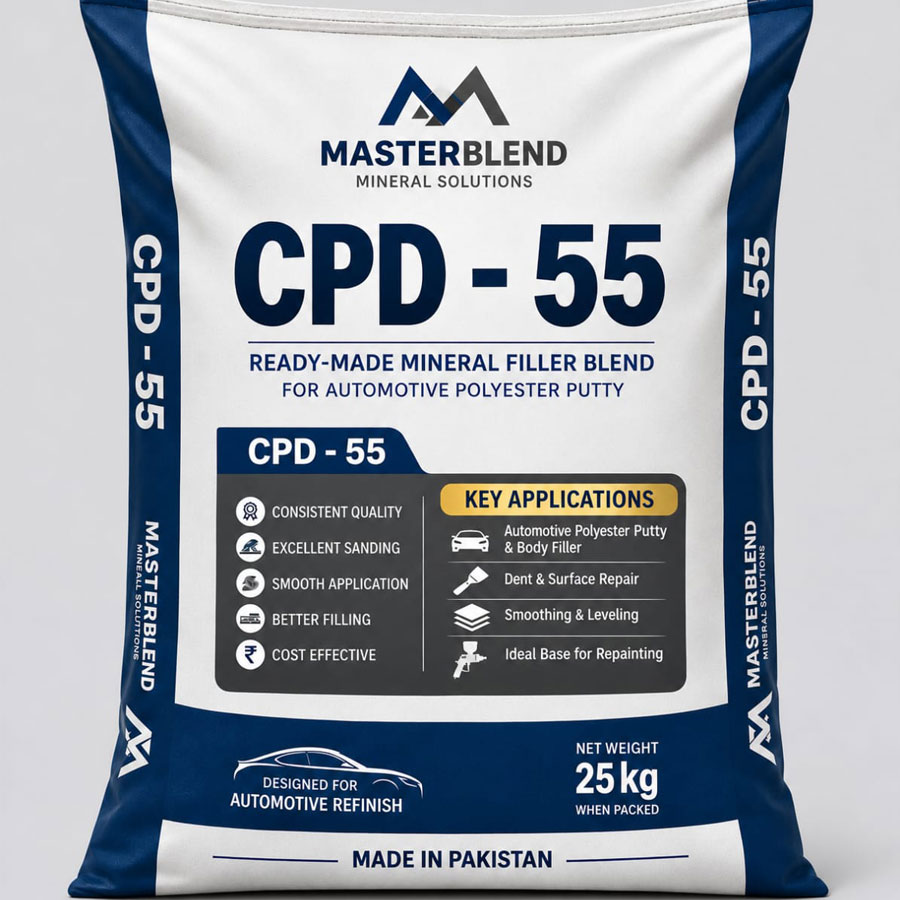
» Available in suitable industrial packaging according to customer requirements.
Storage
» Store in a cool, dry and covered area. Protect from moisture and contamination. Keep bags properly sealed when not in use.